
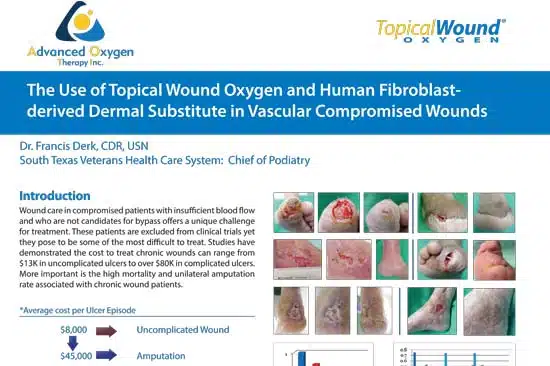
The Use of Topical Wound Oxygen and Human Fibroblastderived Dermal Substitute in Vascular Compromised Wounds
Dr. Francis Derk, CDR, USN
South Texas Veterans Health Care System: Chief of Podiatry
Introduction
Wound care in compromised patients with insufficient blood flow and who are not candidates for bypass offers a unique challenge for treatment. These patients are excluded from clinical trials yet they pose to be some of the most difficult to treat. Studies have demonstrated the cost to treat chronic wounds can range from $13K in uncomplicated ulcers to over $SOK in complicated ulcers. More important is the high mortality and unilateral amputation rate associated with chronic wound patients.
Purpose
To evaluate the efficacy and speed of wound closure on patients receiving Topical Wound Oxygen, weekly applications of Human Fibroblast-derived Dermal Substitute (HFDS) and conventional wound care consisting of infection control, debridement, offloading or compression.
Method
We evaluated 12 ulcers on 9 patients; 2 venous stasis, 5 post operative dehiscences, and 5 DFU’s. All patients received Topical Wound Oxygen, weekly applications of Human Fibroblast-derived Dermal Substitute, and conventional wound care consisting of infection control, debridement, off-loading or compression therapy. Average ulcer size was 4.6 X 1.9 cm. One patient also had a sinus tract. All patients had significant PVD, Renal Disease and 6/9 were chronic smokers. None of the patients were candidates for bypass surgery. 6/9 patients were non-compressible and the other three patients’ ABls were less than .7. The average TBI on the 9 patients ranged from .1-.7 with an average of .33. The average age of our patients was 70 years old (53-81). All patients were unresponsive to conventional wound care and NPWT.
Results
9/9 patients who were not candidates for bypass achieved closure with the combination of Topical Wound Oxygen therapy, weekly applications of HFDS, and conventional wound care consisting of infection control, debridement, off-loading or compression. The average time to closure was 12.7 weeks.
Conclusion
With the use of Topical Wound Oxygen in conjunction with HFDS, we were able to provide an alternative route of care, treatment, and wound closure in a select group of patients who were vascularly compromised, at risk for limb loss, and who were not candidates for bypass surgery. We have found that this technique may provide future benefit for the treatment of challenging, chronic wounds with little potential to heal, based on non invasive studies and no complications.