
The Use of Topical Wound Oxygen {TW0 2 ) in a Complicated Post Surgical Transmetatarsal Amputation with Incision and Drainage of the Foot
FrancisD erk, DPM, CDRU SNS TVHCSC: hief Podiatry ServicesU THSCA: ssistant Clinical Professor
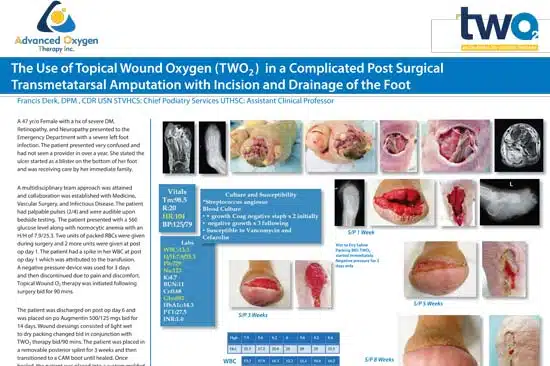
A 47 yr/o Female with a hx of severe DM, Retinopathy, and Neuropathy presented to the Emergency Department with a severe eft foot infection. The patient presented very confused and had not seen a provider in over a year. She stated the ulcer started as a ister on the bottom of her foot and was receiving care by her immediate family.
A multidisci inary team approach was attained and cllaboration was estaished with Medicine, Vascu ar Surgery, and nfectious Disease. The patient had pa pable pulses (2/4) and were audible upon bedside testing. The patient presented with a 560g ucose ev a ong with normocytic anemia with an H/H of 7.9/25.3. Two units of packed RBCs were given during surgery and 2 more units were given at post op day 1. The patient had a spike in her WBC at post op day 1 which was attributed to the transfusion.
A negative pressure device was used for 3 days and then discontinued due to pain and discomfort. Topica Wound 01 therapy was initiated fowing surgery bid for 90 mins.
The patient was discharged on post op day 6 and was aced on po Augmentin 500/125 mgs bid for 14 days. Wound dressings consisted of ight wet to dry packing changed bid in conjunction with
TWO1 therapy bid/90 mins. The patient was aced in a removable posteriors int for 3 weeks and then transitioned to a CAM boot unti hea ed. Once healed, the patient was aced into a custom molded shoe with tier.
Conclusion: This is a very complicated case of a Diabetic Foot infection that responded favorably to a multidisciplinary approach and Topical Wound 02 Therapy. The TWO2 was very effective not only from a wound healing perspective, but also in providing the patient with comfort, direct involvement with her wound care, and ease of use at home.