
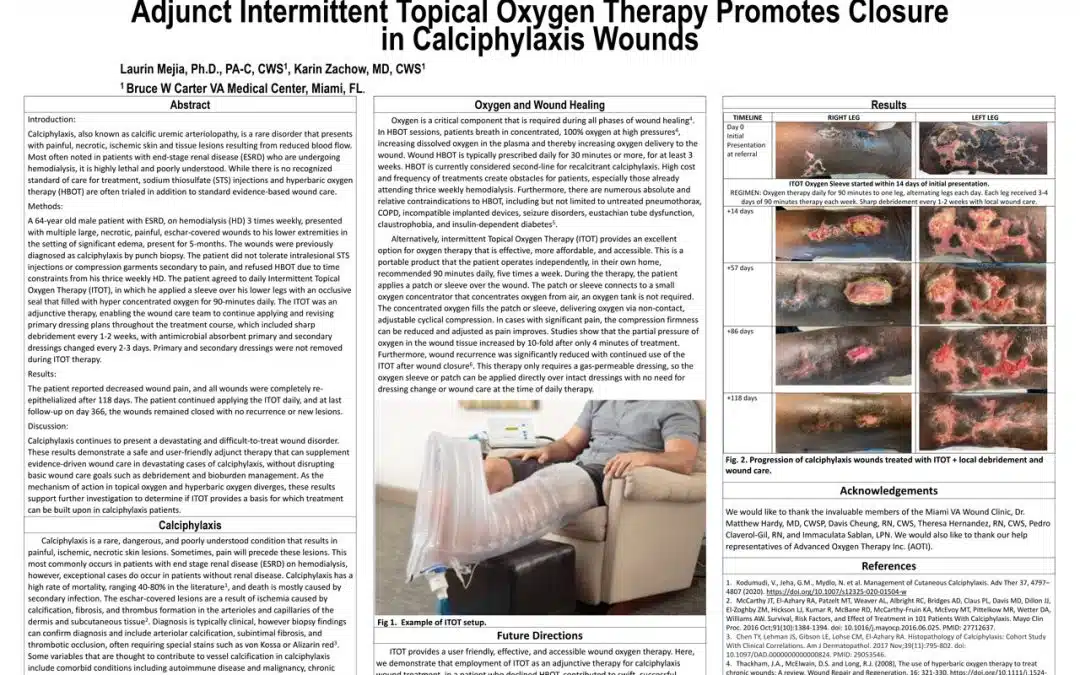
Adjunct Intermittent Topical Oxygen Therapy Promotes Closure in Calciphylaxis Wounds
Calciphylaxis, also known as calcific uremic arteriolopathy, is a rare disorder that presents with painful, necrotic, ischemic skin and tissue lesions resulting from reduced blood flow. Most often noted in patients with end-stage renal disease (ESRD) who are undergoing hemodialysis, it is highly lethal and poorly understood. While there is no recognized standard of care for treatment, sodium thiosulfate (STS) injections and hyperbaric oxygen therapy (HBOT) are often trialed in addition to standard evidence-based wound care.
Topical oxygen therapy in the patient of chronic diabetic leg & foot ulcer
Diabetes mellitus is a metabolic disorder associated with so many complications including diabetic foot syndrome. International Diabetes Federation (IDF) 2021 data reveals that globally 537 million people are suffering from disease & estimated to reach up to 783 million in 2045. In Indian subcontinent (SEA) about 90 million people in the year 2021 estimated to reach 152 million in the year 2045. [1] Diabetic foot syndrome characterized by infection; soft tissue damage & diabetic foot ulcer (DFU) due to diabetic peripheral neuropathy [2]. The prevalence of DFU in type 2 diabetes is 6.4% globally, with 6.38% in South India, and 14.30% in North India. DFU increases risk for lower extremity amputations [3] Many surgical and non-surgical treatments are available to tackle this problem including wound debridement, skin grafting, revascularization, frequent dressing of the wound site with offloading of foot and ultimately amputation in very severe cases to save the life of patient. Primary factor enhancing wound healing process, is oxygen. Hyperbaric oxygen therapy shown benefits in wound healing with adverse effect oxygen toxicity & barotrauma. Topical oxygen therapy (TOT) are safer alternative. It bypasses oxygen transport system & creating oxygen-rich wound bed environment & improved pH levels, helps to cure infection, enhance wound healing & rate of wound closure in chronic non-healing DFUs [4]
Topical Wound Oxygen Therapy in Worsening Diabetic Foot Ulcers: A Case Report
Diabetic Foot Ulcers (DFUs) are a frequent complication of diabetes with attendant morbidity and mortality. There is some increasing evidence that supports the use of Topical Oxygen Therapy (TOT) in chronic DFUs when used in combination with standard wound care1. Specifically, Topical Wound Oxygen Therapy (TWO2) applies cyclically pressurized humidified oxygen within a single use extremity chamber connected to an oxygen concentrator2.
Masterclass Guide: Topical Wound Oxygen (TWO2) Therapy
This Masterclass Guide is a concise overview aimed at exploring the use of Topical Wound Oxygen Therapy (TWO2) and incorporating this into your practice.